|
www.theradiohistorian.org
Copyright
2025 - John F. Schneider
& Associates, LLC
[Return
to Home Page]
(Click
on photos to enlarge)
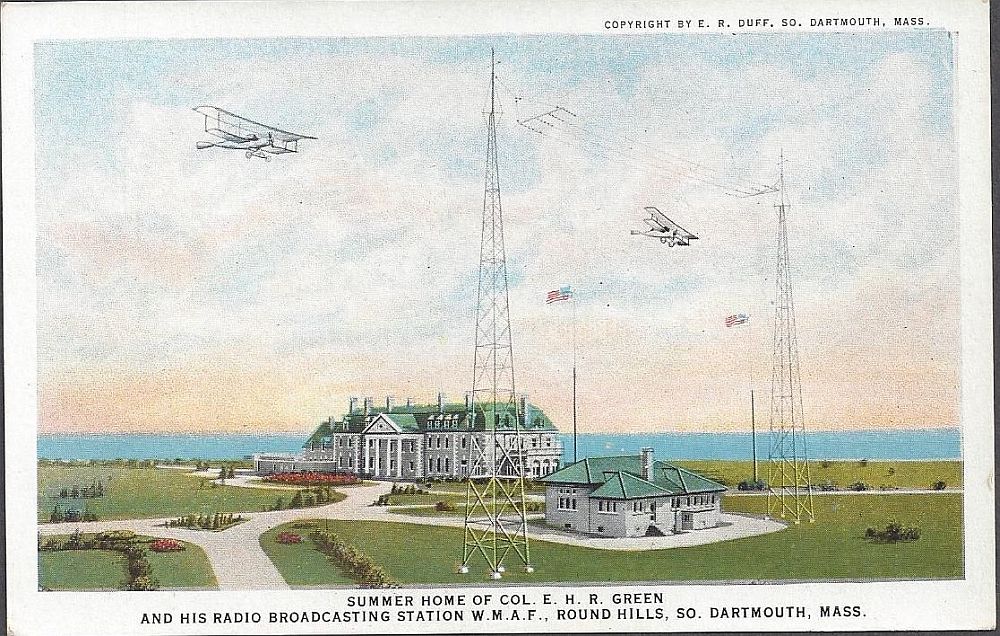
The summer home of Col. E.H.R. Green was the site of his
radio station WMAF in Round Hill, Massachusetts. WMAF was the first station to be permanently
connected to AT&T lines to rebroadcast the programs of WEAF in New York
City, 1924.
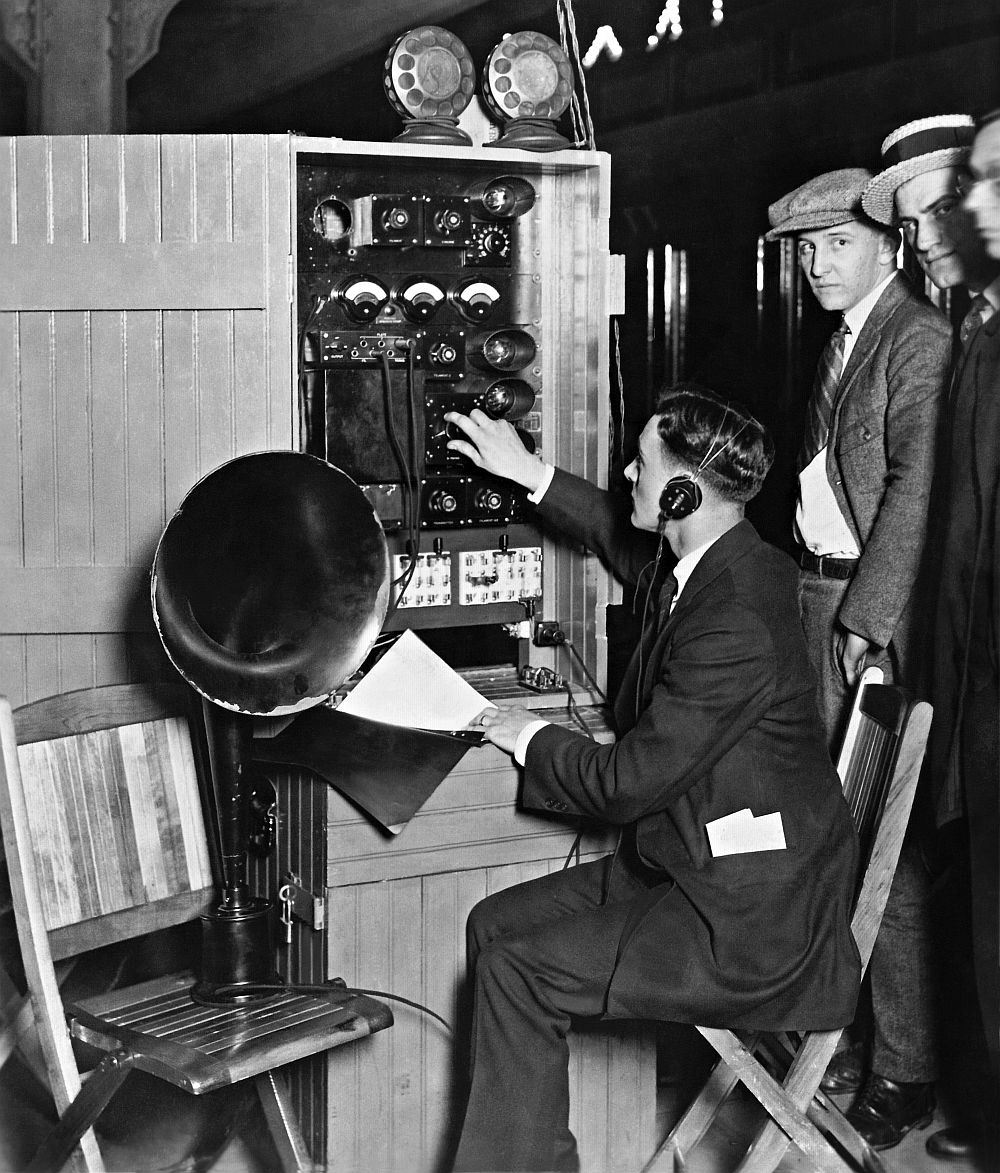
A WEAF engineer manages "portable" amplifiers for a remote broadcast in 1922.
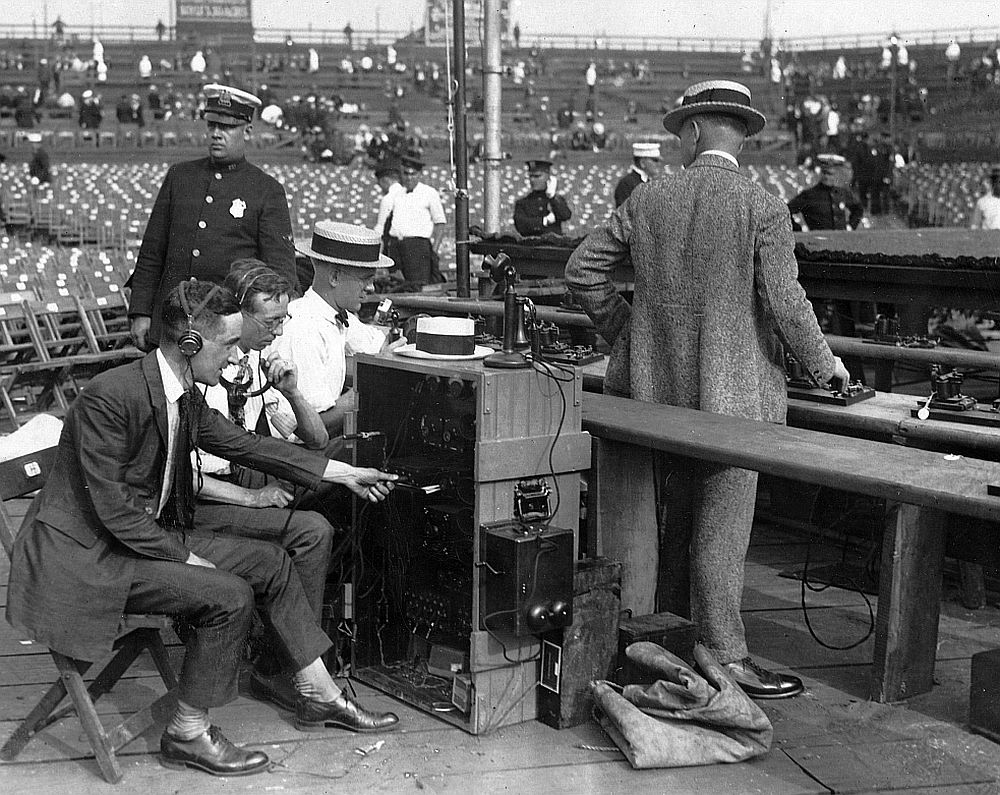
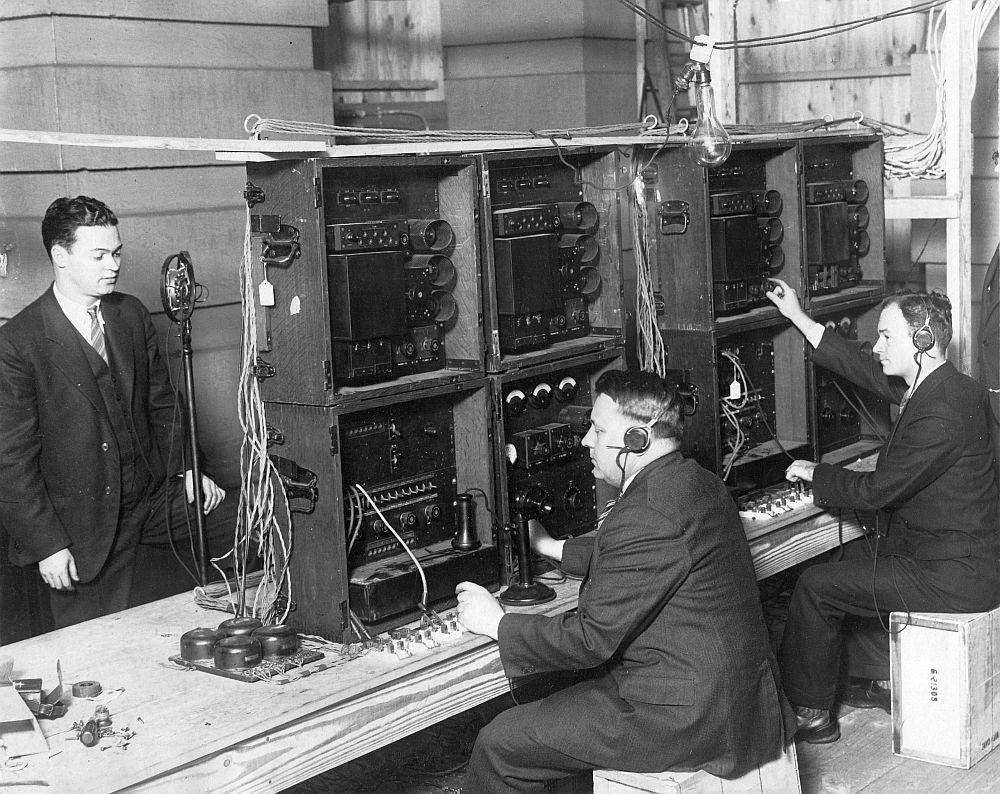
Engineers set up the equipment for the remote broadcast of a boxing match over WEAF in 1923.
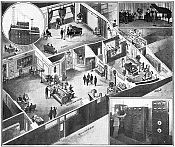
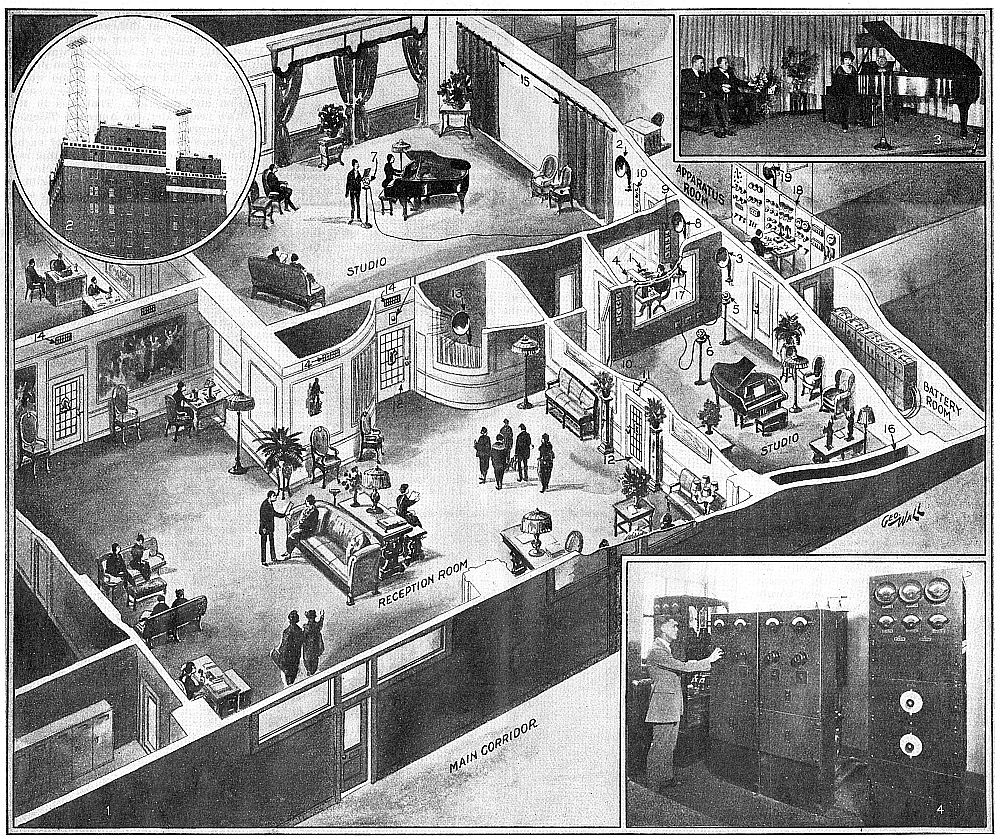
This diagram shows the layout of the WEAF
studio facility on the fourth floor of 195 Broadway in New York
City. (Scientific American Magazine, 1924)
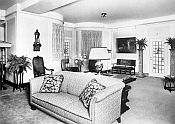
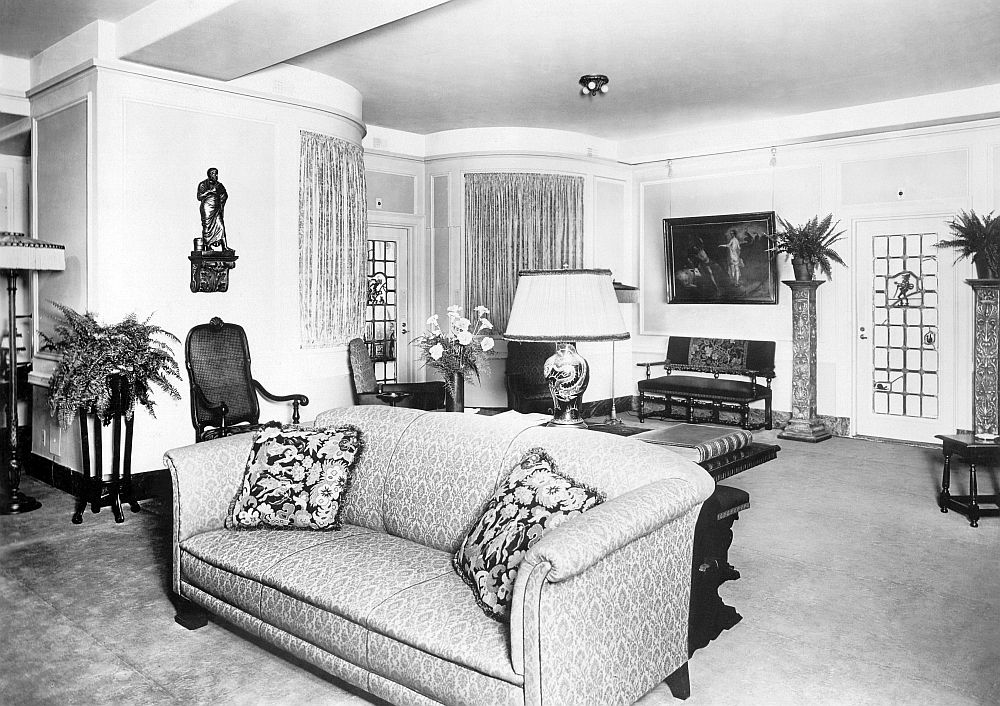
A view of the reception room and entrance to the main studio at WEAF in 1924.
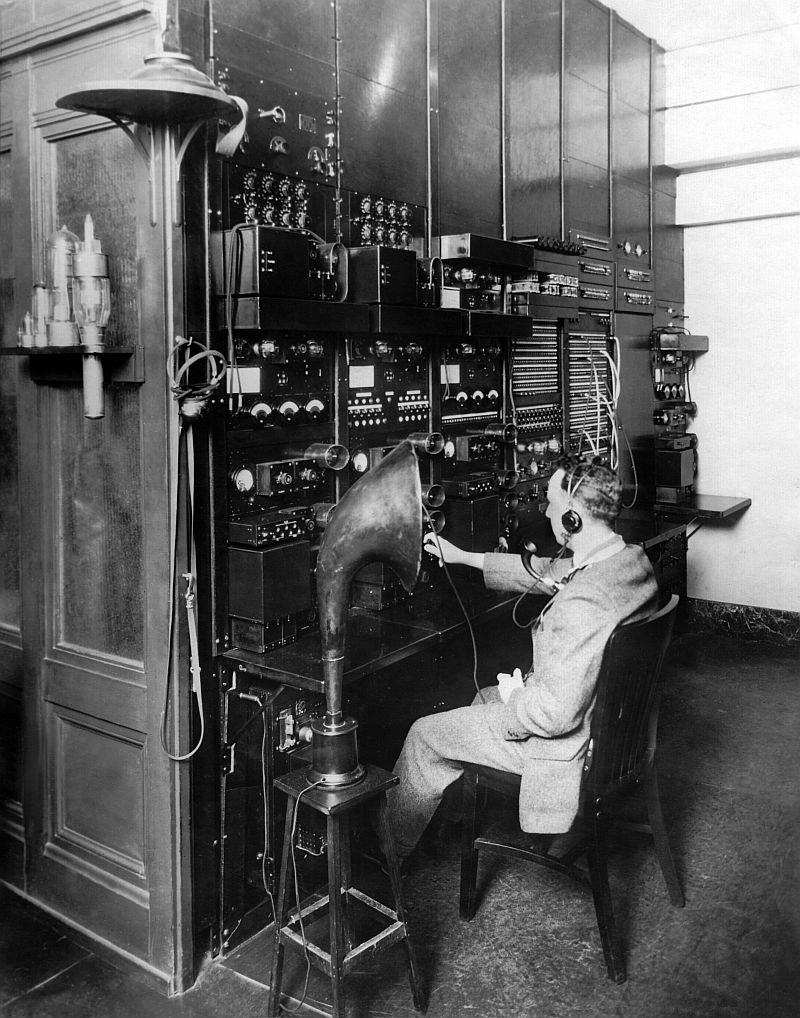
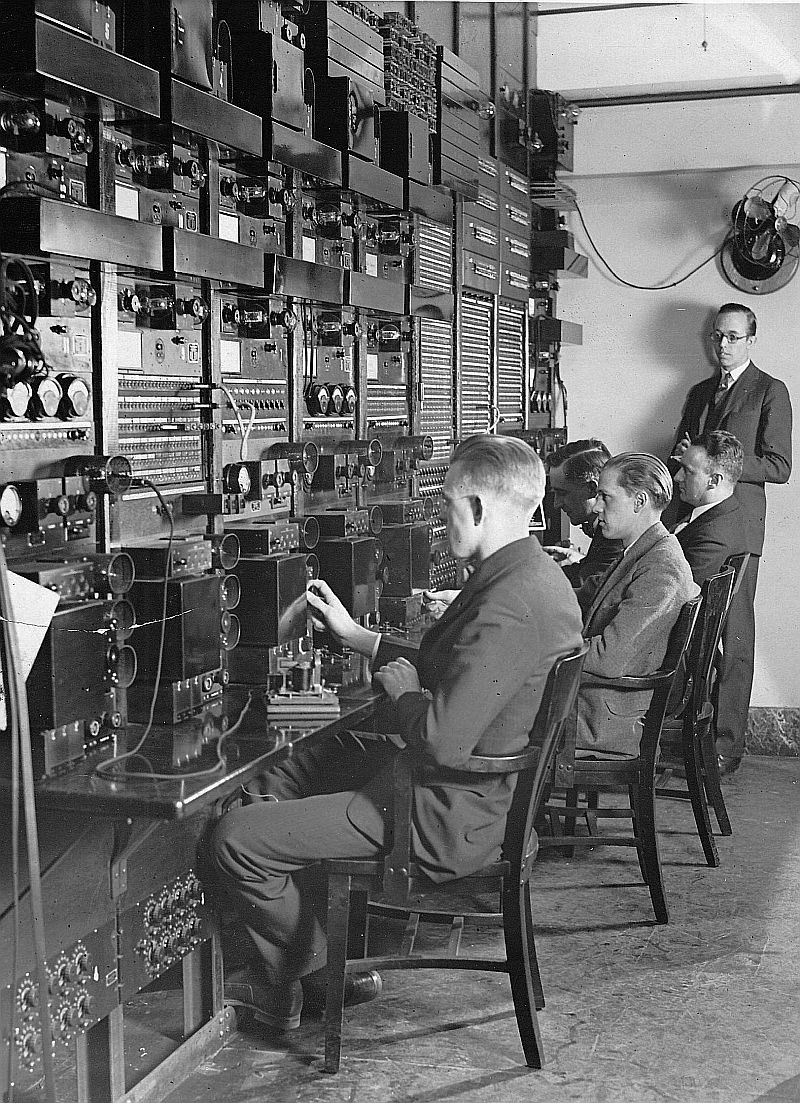
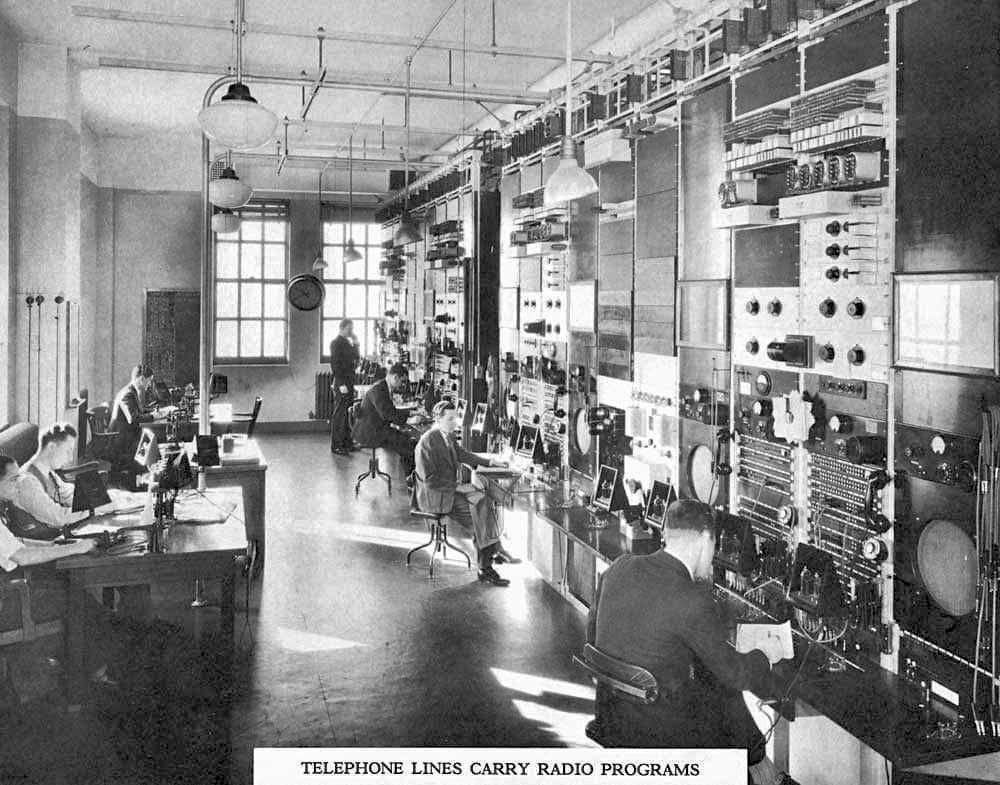
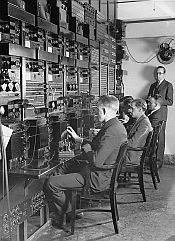
The audio control room at WEAF, 195 Broadway in New York City, 1924.
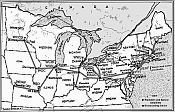
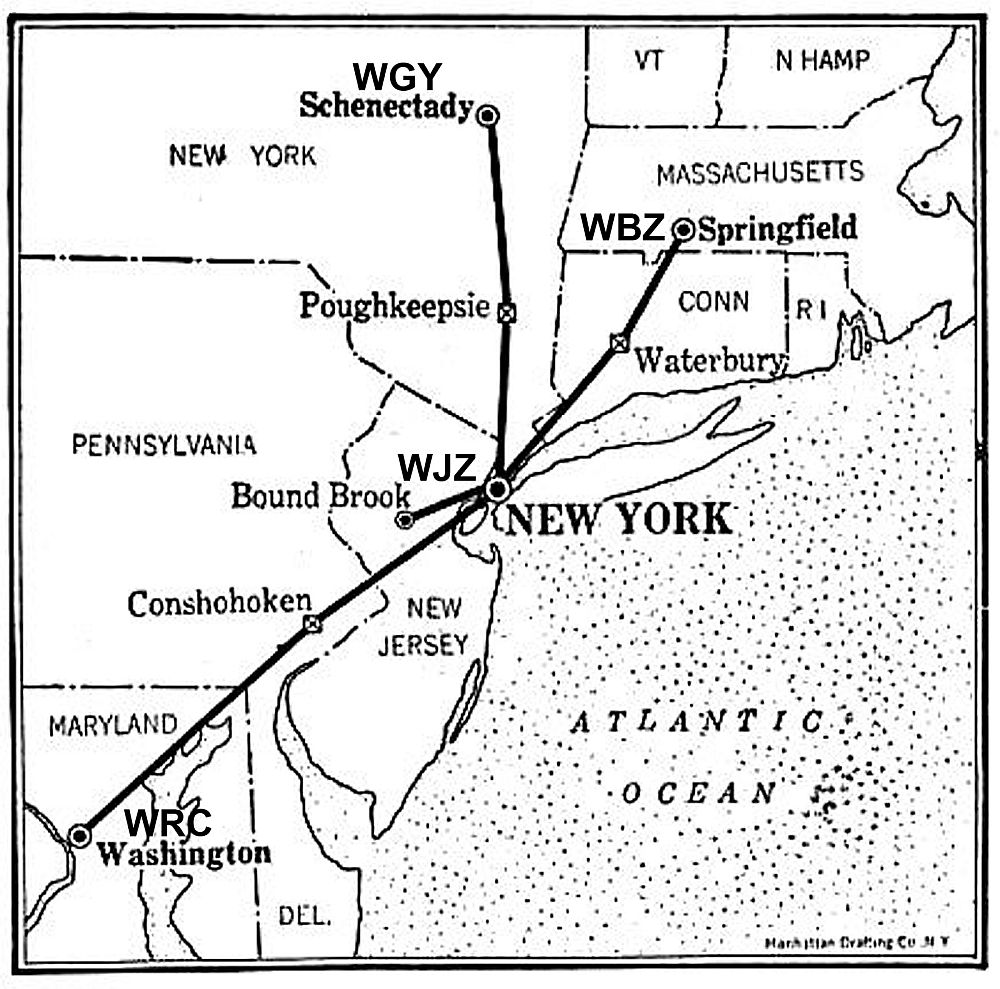
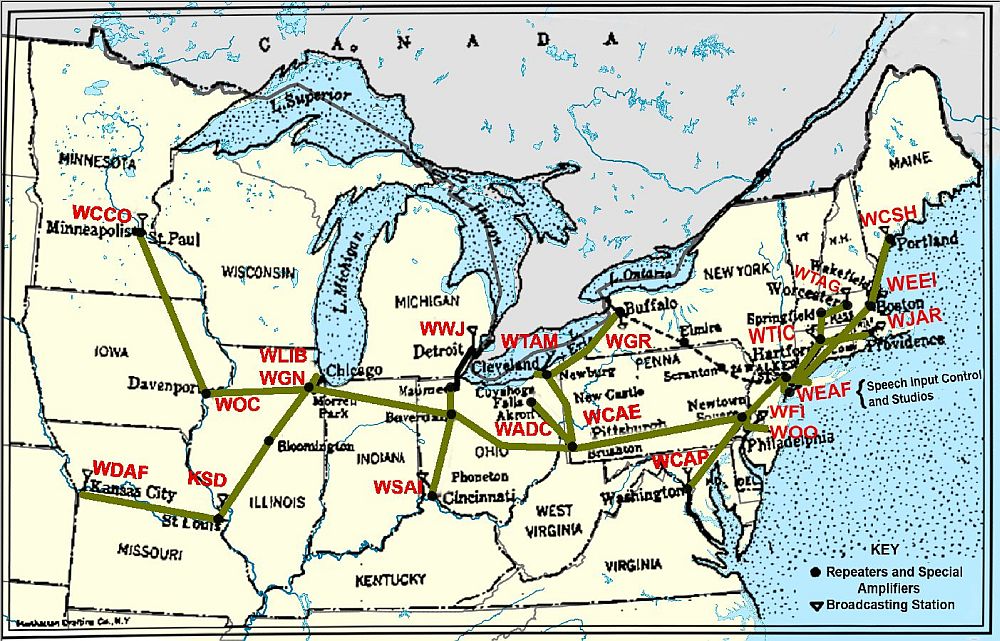
This map shows the affiliated stations and line connections
of the WEAF Red Network in 1925. It
became the NBC Red Network the following year.
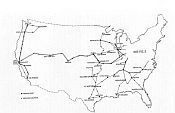
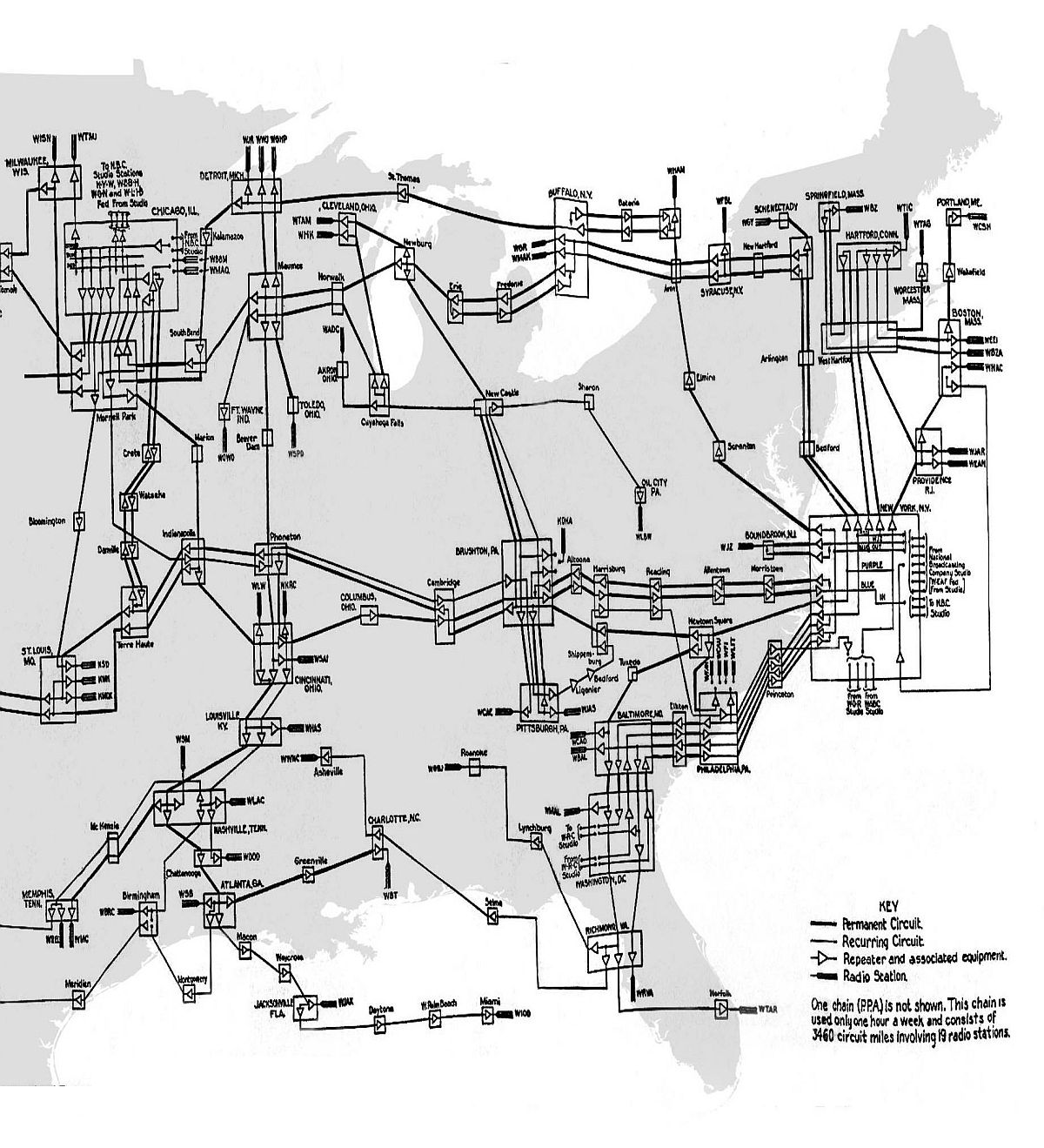
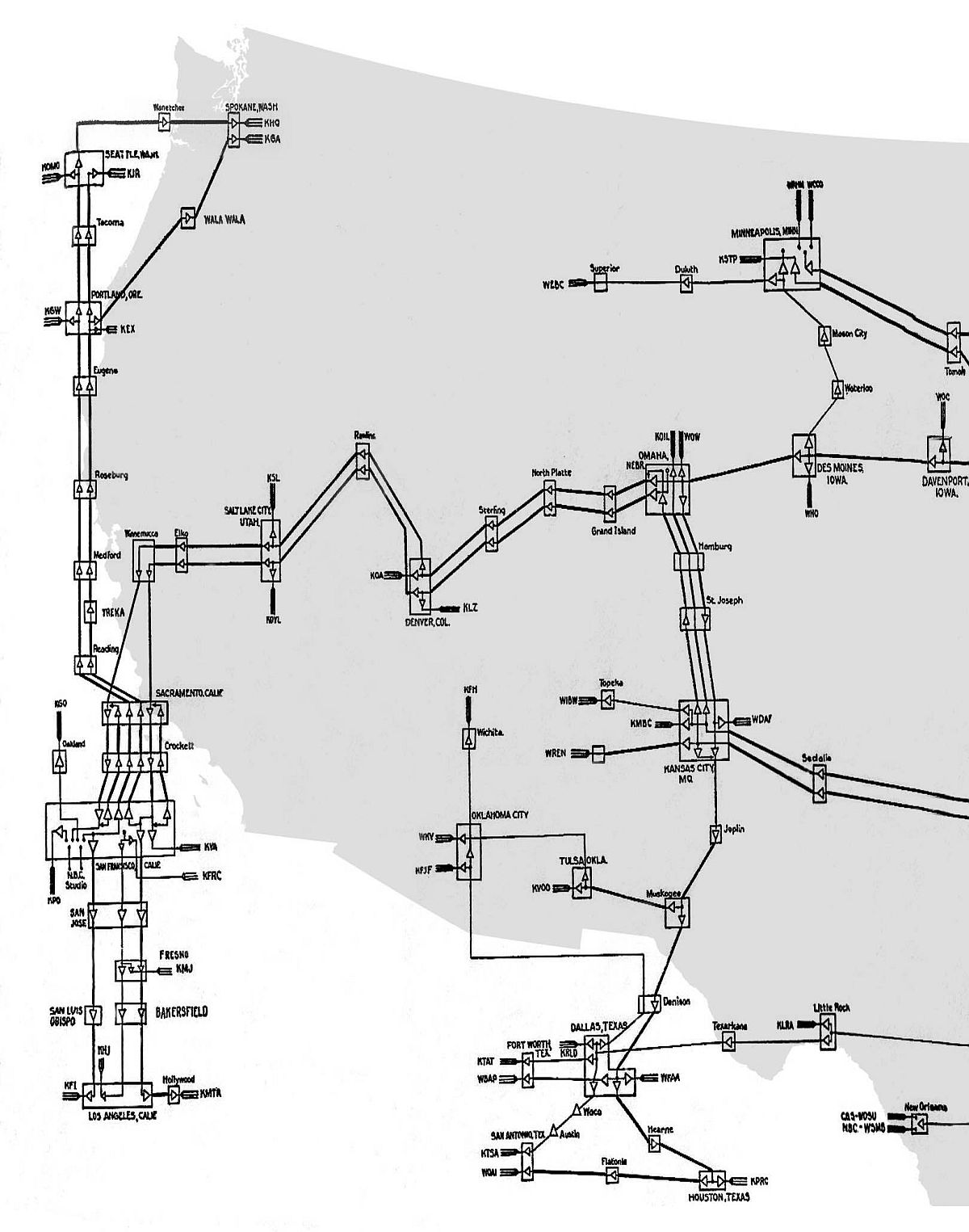
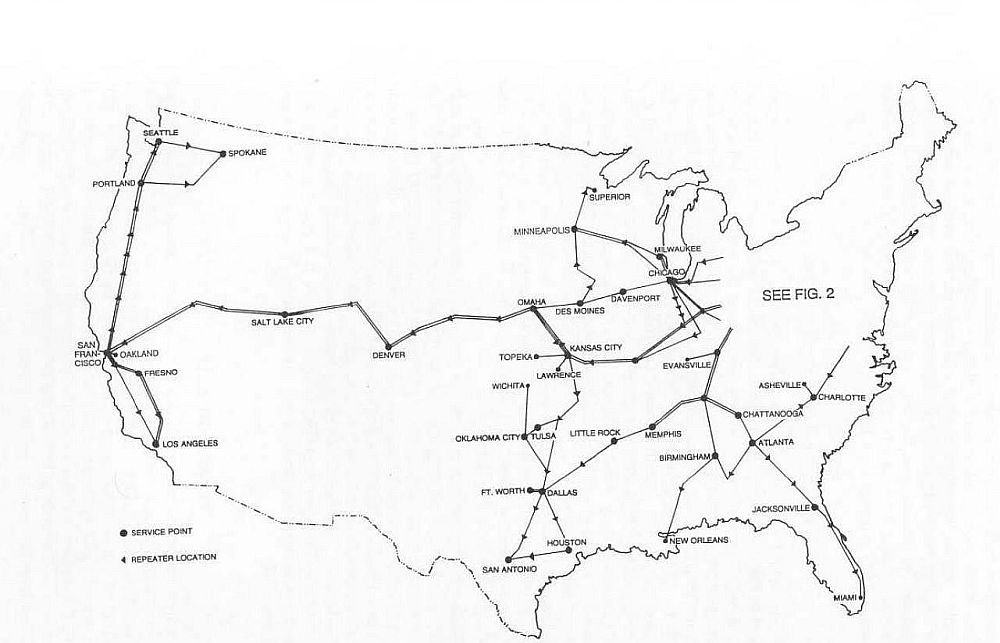
This map shows the configuration of the AT&T
network of equalized broadcast lines in 1929.
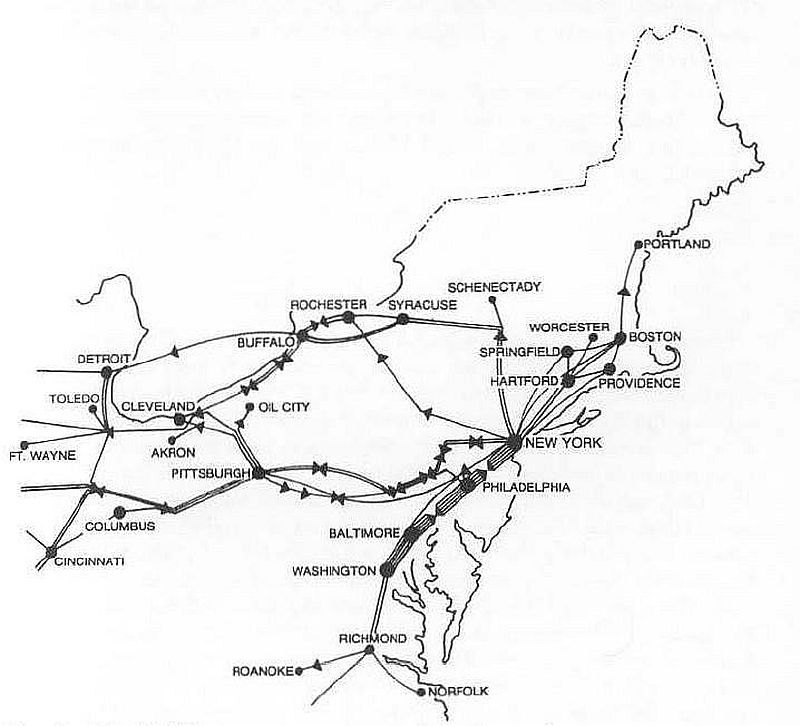
This is a close-up of the AT&T connections in the Northeast USA.
Detail of AT&T broadcast lines on the East Coast, showing the location of repeaters and distribution centers.
Details of AT&T broadcast lines on the West Coast.
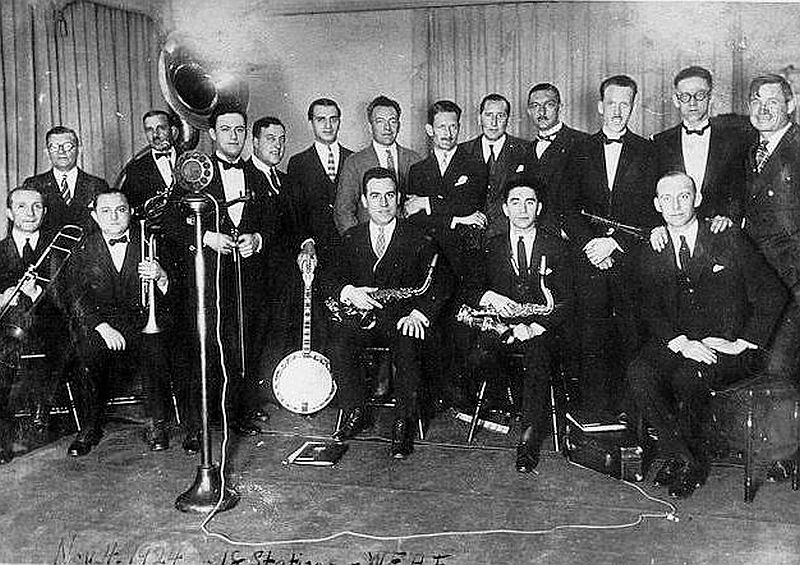
The "Eveready Hour" was broadcast on
an 18-station hookup from WEAF in 1924. Comedian Will Rogers is
at far right. The Waldorf-Astoria Dance Orchestra provided the
music.
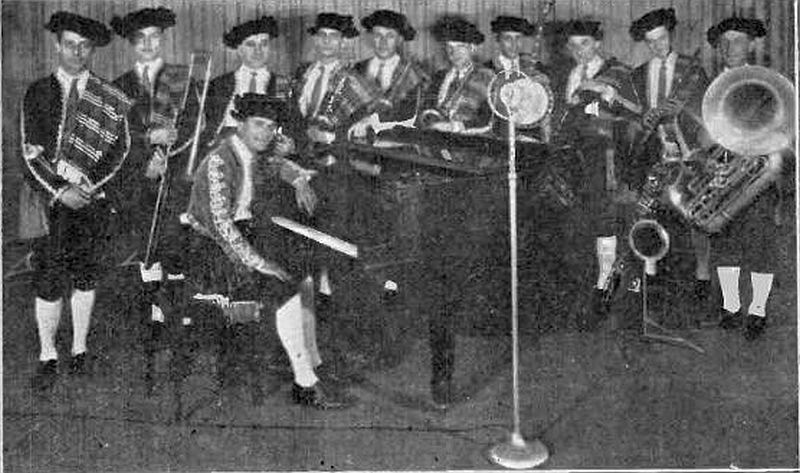
The Ipana Troubadores - a WEAF Red Network program sponsored by Ipana Toothpast, 1926.
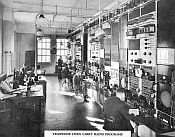
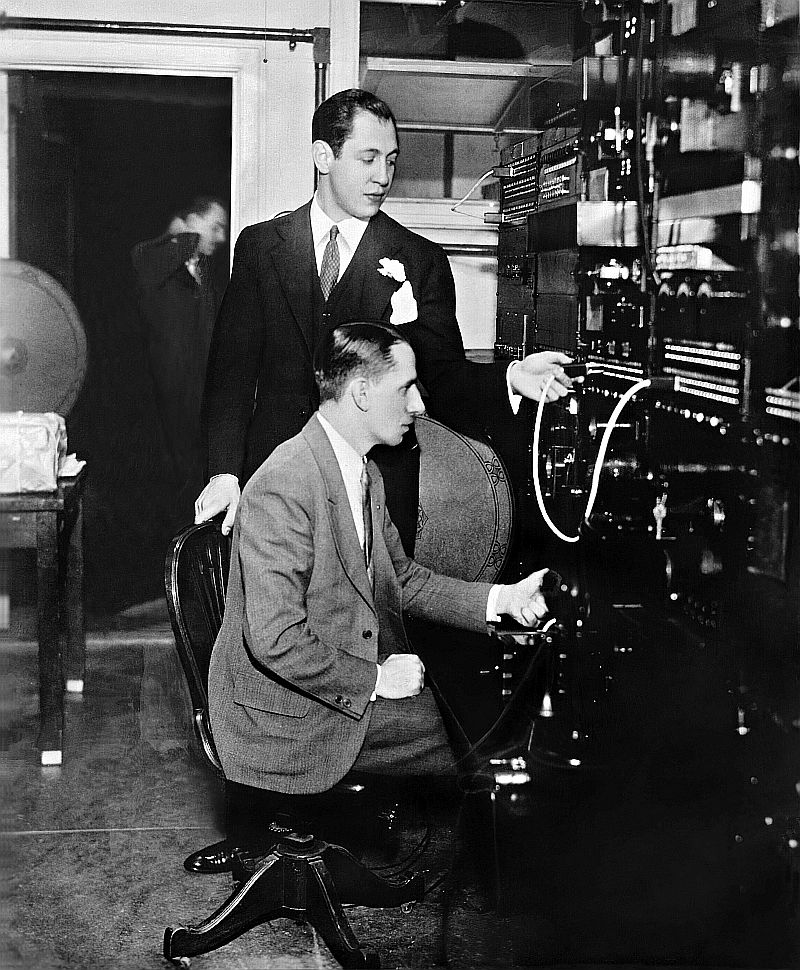
William S. Paley, head of the Columbia Network,
completes a connection bringing CBS programs to the West Coast, January 19,
1929.
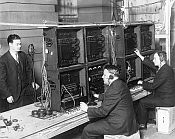
Amplifying
equipment set up under the steps of the Capitol Building for the
network broadcast of Pres. Herbert Hoover's inauguration, 1929.
|
|
THE NEED FOR WIRE LINES
In the beginning years of broadcasting, it quickly became
apparent that some programs needed to originate from outside the radio studio. Wires and amplifiers were employed to bring a
variety of programs in from outside locations.
Remote microphones picked up hotel dance bands, church services, and
ball games. Occasionally, a station
could run its own temporary wires to a nearby location for a single broadcast. (A Portland, Oregon, station owner once famously
dropped a tennis ball attached to a wire into the city sewer, and then fished
it out a few blocks later. ) But most of
the time, this meant connecting the station to the remote location via the
public telephone or telegraph network.
On January 21, 1921 the Westinghouse station KDKA in
Pittsburgh carried the country’s first remote broadcast – a church service from
Calvary Baptist Church. They followed
this with a local address by Herbert Hoover on January 15, 1922; a boxing match
on April 11; the Davis Cup tennis match
August 4-6; and a National League baseball game on August 5. These broadcasts were all transmitted through
telephone lines readily provided by the Pittsburgh Bell System office.
But then the AT&T corporate headquarters intervened,
prohibiting anyone - other than themselves - from connecting external equipment
to their lines. This meant that the
only other option stations had was to use telegraph lines operated by Western
Union and others. But telegraphy lines
were not designed for the transmission of audio. They suffered from continuous hum or noise, key-clicks
that leaked through from adjacent lines, and a restricted audio bandwidth. Broadcasters’ options for making remote broadcasts
were scarce.
In 1919, with the encouragement of the federal government, the
Radio Corporation of America was formed to assume the operations and assets of
the American Marconi Company. The
partners in the new venture were General Electric, Westinghouse, AT&T, and
the United Fruit Company. The four
companies exchanged patent rights with their partners, giving them unbridled
access to the latest radio technologies.
For its part, the new company, RCA, became the sales agency for the
partners’ respective manufactured radio products.
However, the art of broadcasting had not been foreseen when
RCA was organized, and its explosive popularity in 1922 created immediate conflicts
between the partners over issues never contemplated in the original
contract. AT&T, not principally a
manufacturer, was an outlier in this new environment. The RCA contract did give it the exclusive
right to manufacture radio transmitters for resale through its Weste rn Union
subsidiary, but when broadcasting raised its head AT&T began demanding exclusive
new rights that were not recognized by the other partners. It claimed that its monopoly on transmitting
audio messages by wire also gave it the exclusive right to transmit messages by
radio. It also declared that the patent
cross-licensing agreement that formed the RCA Corporation did not include the
ability to transmit audio communications over telephone lines. This was the basis for its prohibition of
telephone line connections by broadcasters.
WEAF DEBUTS
In 1922, AT&T decided it needed to enter the
broadcasting field with a station of its own in New York City. Two other RCA partners had already formed
their own stations: Westinghouse operated
KDKA in Pittsburgh, WBZ in Boston, and WJZ in Newark, NJ; General Electric had WGY in Schenectady. But in 1922, all broadcasters were required
to share time on a single frequency, 360 meters (833 kHz). AT&T, being late to the game, found
itself sharing time with 15 other stations already transmitting in the New York
area.
On August 3, 1922, AT&T debuted WBAY, broadcasting from
the roof of the Long Lines building at 24 Walker Street. To its dismay, the coverage was dismal
because the steel infrastructure of the building was absorbing a good part of
the transmitted signal. So, on August
16, the transmissions were moved to another AT&T transmitter on West Street
which had the call sign WEAF. A local
phone line connected WEAF with the studio on Walker Street.
From its inception, WEAF was conceived by AT&T to be a
“Toll” station. That is, it would
provide broadcast time for a fee to anyone who wished to transmit a “message”
to the public – in essence, advertising.
It also claimed for itself, through patent rights and the RCA partner
agreement, the exclusive right to broadcast messages for hire to the
public. On August 28, WEAF carried the
country’s first radio commercial – a ten minute promotional announcement by an
apartment building complex.
NETWORK BROADCAST TECHNOLOGY IS DEVELOPED
Remote broadcasts were immediately a part of WEAF’s program
schedule, given its ready access to AT&T’s national network of telephone
lines. In telephone parlance, a remote
broadcast was referred to as a NEMO (“Not Originating Main Office”) – a term
that would become used generally by the broadcast industry over decades. A NEMO circuit order consisted of an
equalized line and a separate “Order Wire” telegraphic line which was used for
communication between the connection points.
Because AT&T reserved for itself the right to connect to
its phone lines, was quick to make use of it.
On October 8, 1922, WEAF broadcast the Princeton-Chicago football game
from Stagg Field by AT&T long lines from Chicago. This was followed by the Yale-Brown game from
New Haven, and the Princeton-Harvard game from Cambridge.
The first connection between two radio stations occurred on
January 4, 1923, when WEAF combined with WNAC in Boston for a three-hour
broadcast. The occasion was the
Massachusetts State Bankers’ Association banquet in Boston, from which both
speeches and musical entertainment were programmed. A temporarily equalized line was run from New
York to Boston with several repeater amplifiers along the 300-mile path. It carried the Boston program to New York,
and then it was reversed to carry entertainment from WEAF to Boston. A separate local line was run from the
banquet hall to the WNAC studios. A
standby program line and telegraphy order wire line were also installed. An estimated audience of 100,000 listeners
heard the broadcast from the two stations.
The WNAC experiment was an audience success, but AT&T
engineers were not happy with the quality.
It suffered from line noise, key clicks, crosstalk from phone calls into
the program line and vice versa, as well as insufficient frequency response for
music performances. They began working
on better solutions. The development of an active equalizer (Western Electric
1-A) allowed them to transmit reasonable audio quality through specially-dedicated
lines of the network.
A system of equalized lines was developed, with loading
coils connected every 3,000 feet to maintain adequate frequency response. Manned amplifier stations spaced at 50-200
mile intervals boosted the signal level that had decreased due to line
loss. Standard telephone amplifiers were
modified to provide better frequency response, from 200 Hz to 5 kHz, and to
adjust for any frequency response imbalance.
Because amplifier gains varied with battery voltage fluctuations, and line
losses changed with the weather, it was necessary to conduct daily gain and
equalization adjustments at each point along the line. To facilitate this process, “order wire” Morse
lines were used by the broadcasters and repeater stations to communicate via
telegraphy.
STATION HOOK-UPS BECOME MORE FREQUENT
Starting in 1923, AT&T made liberal use of its phone
line facilities to share programs with other radio stations over temporary
hookups.
- June 7, 1923 – A WEAF broadcast from the National
Electric Light Association convention at Carnegie Hall was sent to KDKA, KYW,
and WGY.
- June 21, 1923:
A speech by President Harding was broadcast over KSD in St. Louis and forwarded
by wire to WEAF The next day, WEAF
carried another Harding speech from Kansas City. (A
planned third Harding broadcast over six stations from San Francisco never took
place; Harding died August 2 in a San Francisco hotel.)
- ·December 6, 1923: Calvin Coolidge’s message to Congress was
broadcast over WEAF, KDKA, KYW, WGY, KSD, WDAF, and WFAA.
- September 12, 1924 – “National Defense Day” was
broadcast from Washington, DC, over 18 stations connected through 39,000 miles
of audio lines.
At first, long distance lines would be temporarily removed
from telephone service and equalized for broadcast use. After the broadcast, the lines would be
returned to regular service. But the
labor involved in this process convinced AT&T that it needed to install
permanent lines for the purpose of broadcasting.
Their first opportunity to do so came in July, 1923. Coronel Edward H.R. Green was an eccentric
millionaire who, as a hobby, assembled a complete Western Electric-equipped
broadcasting station at his summer estate in Round Hill, Massachusetts. Starting in the summer of 1923, he broadcast
phonograph music from his personal record collection each evening to entertain
local residents. But ,to his surprise, the
local residents complained that his broadcasts were blocking their reception of
WEAF from New York. So Green approached
AT&T and offered to pay the line and program costs to bring WEAF’s programs
to his station, where they would be rebroadcast for the local audience.
AT&T installed a permanent 5 kHz equalized line to
Providence, RI, and from there a temporary line carried WEAF programs to
Colonel Green’s station. WEAF’s programs
were rebroadcast daily from WMAF from July 1 until September 30, when Green
closed his estate down for the winter.
AT&T then made an arrangement with another Western Electric station,
WJAR in Providence, and WEAF’s programs began being heard there starting on
October 19.
On July 4, 1923, AT&T opened WCAP in Washington,
DC. Permanent program line connected
WCAP with New York, and it mostly rebroadcast the programs of WEAF. Coincidently, WCAP was ordered to share time
on its 469 meter frequency with WRC, the D.C. station of WEAF’s arch-enemy,
WJZ. Postal Telegraph Company lines
brought WJZ’s programs to Washington for broadcast over WRC.
On May 30, 1924, a Memorial Day speech by President Coolidge
was carried over WCAP and rebroadcast by both WEAF and WJAR. After that date, the three stations continued
to be hooked up for the regular sharing of programs.
THE WJZ NETWORK
As the internal conflict between AT&T and the other RCA
partners intensified, New York’s two powerful stations, WEAF and WJZ ,become
bitter rivals. WEAF was selling
advertising and sponsored programs, which they claimed as an exclusive
right. RCA’s station WJZ chafed at being
restricted from advertising. It was producing
equally excellent programs but broadcast them for free. WEAF saw that as unfair competition – how
could they sell air time to a sponsor when WJZ was willing to broadcast the
same program for just the production costs?
As a further point of conflict, the RCA station was denied
the use of AT&T’s superior telephone lines.
WJZ was initially installed in
1921 by Westinghouse at its factory in Newark, and RCA took over the operation late
in 1922. In Newark, the station always
suffered from the difficulty of coaxing New York entertainers to make the long trip
to Newark for a broadcast. At first,
attempts were made to broadcast from a New York studio at the Waldorf Astoria
Hotel, feeding the programs to the Newark transmitter over a Western Union
cable pair, but the circuit suffered from significant noise and telegraph
crosstalk. Finally, RCA consolidated the
WJZ studio and transmitter at a new site in the Aeolian Building in New York on
May 16, 1923. (A second, lesser RCA
station, WJY, also broadcast from the same location for a few years.)
Unable to utilize AT&T phone lines, WJZ made the best of
its Western Union option, finding new ways to route its connections to minimize
noise and crosstalk. On November 17,
1922, WJZ broadcast the first Presidential remote, carrying Warren G. Harding ‘s
speech from Madison Square Garden to its studio on a Western Union line. In August, 1923, RCA opened WRC in
Washington, DC and connected it to WJZ on Postal Telegraph lines. That December, a permanent Western Union line
was established with WGY in Schenectady, later extended to WSYR in
Syracuse. A connection with WBZ in
Boston in 1925 formed the structure of WJZ’s modest network.
POLITICAL CONVENTIONS
1924 was a presidential election year, and the WEAF and WJZ
networks both came into heavy play keeping the country informed of election
activities.
The Republican National Convention was held in Cleveland
from June 10-13. The facilities of WTAM there
were used to transmit the convention proceedings to 19 stations over the WEAF
network. Graham McNamee and Philips
Carlin were tapped to broadcast the convention proceedings, which were heard by
an audience of millions. Afterwards, the
remote broadcast amplifiers were shipped to New York for the Democratic
National Convention, which began on June 24 at Madison Square Garden. That convention, broadcasting to the same
station group, lasted a grueling fifteen days before candidate John W. Davis
was nominated on the 103rd ballot.
The convention was also covered by Andrew J. White and Norman
Brokenshire for WJZ, with a Western Union feed to WGY.
WEAF fed later election activities to a temporary hookup of
stations. A speech by Calvin Coolidge to
the U.S. Chamber of Commerce was carried by 22 stations on October 23. His final campaign address on Election Eve
went to 27 stations, including five on the West Coast connected by standard
telephone circuits. For the election
night broadcast, Will Rogers entertained listeners with stories and jokes
between ballot results. Coolidge
defeated Davis on that night, and his inauguration on March 4 was broadcast
over both the WEAF and WJZ networks.
WEAF FORMS THE “RED NETWORK”
In broadcasting’s first year or two, radio listeners were simply
thrilled to hear anything that came over the airwaves. Around the country, second-class or amateur
musicians and singers were recruited to fill the stations’ time schedules,
usually performing without charge.
But the public soon tired of mediocre talent and
increasingly sought out better quality programs. This was difficult for stations outside of
the New York Metropolitan Area, as most of the country’s top performing talent
was located there. For their parts, both
WEAF and WJZ had access to the nation’s best talent, but it came at a hefty price
at a time when advertising revenue was minimal or non-existent.
The natural solution was for the New York stations to share
their programs with stations in other cities, and to also share the program costs
with them. What was needed was a means
to transport the audio between cities.
Telegraph lines, which had never been designed to carry audio, did not
provide the necessary audio quality.
Shortwave links were tried, but their propagation was unpredictable. The only viable option was to use the
specialized program lines of the AT&T network, which that company was reserving
exclusively for themselves.
Initially, AT&T’s plan had been to set up a network of
its own stations in major cities around the country, feeding them with its own
lines. But they had arrived late to the
game, and found that good frequencies in most of the country’s major cities
were no longer available. The only remaining
option was to contract with other stations to rebroadcast their programs, and
to share the costs between those stations and the program sponsors.
In 1924, AT&T developed its network business plan. It would contract with the best stations in
each major city reachable by their equalized broadcast lines. They wanted the stations with the best
coverage, preferably those who were already using Western Electric
equipment. The available lines at that
time principally covered the Northeast and upper Midwest, reaching as far west
as Kansas City and Dallas, although they extended no farther in the Southeast
than Washington D.C. Programs originating at WEAF would be fed over
AT&T long lines, many of which would be repurposed from telephony service
during evening (off-peak) hours. 21
stations were offered the opportunity to join the network. The line costs for all sponsored programs
would be paid by the respective sponsors, and each station would also be paid
for its air time. In turn, the stations
would pay AT&T for the program and line costs of all sustaining
(unsponsored) programs. It was presumed
that the two options would tend to cancel out, so that the cost to most
stations for joining the AT&T network would be minimal.
21 stations were initially offered the opportunity to join
the network, but most of those stations balked at paying the hefty line costs
to their cities. As a result, when the
network began operations in October, 1924, it was being heard over just six
stations: WJAR Providence, WEEI Boston,
WGR Buffalo, WCAE Pittsburgh, and the two AT&T stations. The stations received 3 hours of programs
nightly from WEAF. The hookup was
informally called the “Red Network” because the network’s lines on the phone
system maps were drawn in red pencil.
The name stuck.
After its weak beginning, AT&T realized that an extra
effort would be needed to jump-start the operation. So, starting on January 1, 1925, WEAF fed the
network with a sustaining broadcast of Metropolitan Opera stars John McCormack
and Lucrezia Borzi. It was the first of a series of ten one-hour broadcasts
provided at no cost to the network by AT&T. Thirteen stations signed up for these “WEAF
Grand Opera Company” broadcasts, and the series finally gave impetus to the
network concept to succeed. By that Spring,
13 stations in 12 cities had joined the network.
Now, with enough stations on the network, WEAF was able to
attract sponsors for many of their programs.
Some of their most successful of these shows were “The Eveready Hour”,
“The Atwater-Kent Hour”, “The Clicquot Club Eskimos”, “The A&P Gypsies”,
and the “Gold Dust Twins”. These
programs were sold as “goodwill” promotions for their sponsors, and direct-sale
announcements were prohibited. The
sponsor’s benefits were limited to program naming rights and indirect
promotional announcements in the openings and closings of the programs.
By December of 1925, the WEAF Red Network was a success, serving
26 stations, as far west as KSD in St. Louis.
AT&T was finally seeing a modest profit for its efforts.
CONFLICT RESOLVED
It wasn’t long after the formation of RCA that internal
conflict began between AT&T and its “Radio Group” partners over the issues
of broadcasting and patent rights. The RCA
partners refused to recognize the aggressive rights AT&T was claiming for itself,
including exclusive rights to network broadcasting and paid advertising. By 1924, AT&T had disposed of all of its
RCA stock and was in open conflict with its partners. According to the original contract, any
conflicts between the partners were to be settled by arbitration, and so a long
and convoluted arbitration hearing took place over the 1924-25 period. Finally, the single arbitrator assigned to
the case decided most issues in favor of the Radio Group. This led to further negotiations between the
parties, and the result was, in the summer of 1926, that AT&T sold WEAF and
its Red Network to RCA for $1 million.
Essentially, AT&T finally realized that its earnings
from the operation of WEAF and its fledgling network were relatively
modest. Their “experiment” with
broadcast had also thrust them into the entertainment business, which was not
their core focus as a technology company.
In fact, the real business they were aptly and uniquely suited for was
the leasing of broadcast quality phone lines.
They were the only organization capable of providing such a service, and
the profits to be realized would be lucrative.
Upon its acquisition of WEAF and the Red Network, RCA,
General Electric and Westinghouse joined together to form the National
Broadcasting Company (NBC). The WEAF Network
was reorganized as the NBC Red Network, with its inaugural broadcast over 25
stations occurring on November 15, 1926.
For its part, the WJZ Network was finally given access to AT&T lines
and began operations as the “Blue Network” on January 1, 1927. Because equalized broadcast lines did not
reach farther west than Kansas City at that time, a new NBC network called the “Orange
Network” was established in San Francisco.
It fed seven Pacific Coast stations over Pacific Bell long lines, broadcasting
duplications of the New York programs performed by a West Coast staff of
artists, actors and musicians.
Back in New York, the intensely rival management and staffs
of WEAF and WJZ found themselves uncomfortably merged into a single operation
at the WJZ Aeolian Hall studios. In
1927, NBC moved into a six-studio suite on the twelfth and thirteenth floors of
a new office building at 711 Fifth Avenue. That facility was immediately outgrown, and By
1930, plans were already underway for an even larger and grander facility – NBC
Radio City.
NBC’s first coast-to-coast broadcast was the Rose Bowl Game
from Pasadena on January 1, 1927, with Graham McNamee at the microphone, but it
was fed eastward over standard low-quality telephone lines. Finally, in December, 1928, AT&T
completes the installation of one broadcast quality line over the Rocky
Mountains. This incorporated KOA in
Denver, KSL in Salt Lake City, and the Pacific Coast Orange Network into a
nationwide chain of 58 stations which broadcast a selected mix of Red and Blue
Network programs. A second line was
added in the mid-1930’s, and the Red and Blue Networks were finally
coast-to-coast operations.
By the end of the 1920’s, AT&T’s broadcast network had
grown to more than 28,000 miles of full-time lines feeding 123 stations.
ADDITIONAL NETWORKS SPREAD THEIR WINGS
As AT&T continued to build out its nationwide network of
broadcast-quality lines, other organizations saw opportunity in forming their
own networks. There were nearly 600
radio stations in the United States in the late 1920’s, and only ten percent of
those were NBC affiliates. Certainly,
the remaining stations represent additional opportunity.
Starting in 1925, General Electric operated the New York
State Network, connecting WGY, WFBL, WHAM and WMAK. Bare telegraph lines were used, with the equalizing
amplifiers built and provided by G.E. It
operated into the mid-1930’s.
Back in New York, United Independent Broadcasters was formed
by Arthur Judson and George Coats in January of 1927 for the purpose of organizing
a new network. The Columbia Phonograph
Company was brought in as an investment partner in April. The Columbia Phonograph Broadcasting System debuted
on September 18, 1927, feeding ten hours of programs per week to sixteen
affiliated stations from rented studios at WOR in New York. (The first control room was in the men’s
room!) But a complete lack of
advertising sales and inept internal organization caused Columbia Phonograph to
back out after losing $100,000 in only three months of operations. For the next few months, the ownership of the
endangered network was tossed around like a hot potato. It finally landed in the hands of 27-year-old
William Paley, the son of a wealthy Philadelphia cigar manufacturer.
Paley was a radio neophyte, but energetic and a quick
learner. He shortened the name to the
Columbia Broadcasting System, made crucial changes to the affiliate agreements,
and signed dozens of new stations and important major advertisers, tripling the
revenue in just a few months. He changed
the programming emphasis from highbrow music to more mainstream tastes, signing
the Paul Whiteman Orchestra and a young singer named Bing Crosby. Vaudeville entertainers and comedians began
appearing on the Columbia Network, including Jack Benny, Burns and Allen, and
Fred Allen. Announcer Ted Husing was
sent out to broadcast sporting events.
In need of more cash, he sold 49% of the company to Paramount Pictures
(later buying it back in 1932). He purchased
New York’s WABC (now WCBS) and moved the studios out of WOR. And he signed a ten-year lease for five
floors of studio and office space in a new building at 485 Madison Avenue,
close to the major New York ad agencies.
By 1931, at the bottom of the depression, Columbia had 85 affiliates,
400 employees, and showed a net profit of $2.3 million.
OTHER ATTEMPTS AT FORMING A NETWORK DON'T GO WELL
In 1928, bankers Adolph Linden and Edmund Campbell bought an
overextended group of West Coast stations (KJR Seattle, KEX Portland, KGA
Spokane, and KYA San Francisco). They
formed the American Broadcasting Company (unrelated to today’s ABC). The network’s ambitious network program
schedule debuted on December 22, 1928, with a three hour program sponsored by
the Union Oil Company. It fed a full
schedule of high-class programs originating from its San Francisco and Seattle
studios on alternate nights. No expense
was spared to offer the finest entertainment programs to its listeners. The ABC network attracted well-paid talent
from all over the country (including a young musician named Meredith
Willson). In January of 1929, new
telephone circuits were added to feed additional stations in Omaha (KOIL),
Denver (KLZ), Salt Lake City (KDYL) and Los Angeles (KMTR). The burgeoning
network now had eight stations. On June
1, ABC welcomed five additional affiliate stations to the network: WIBO Chicago, WIL St. Louis, WRHM Minneapolis
(aka WLB), KFAB Lincoln, Nebraska, and KTNT Muscatine, Iowa. KFBK
in Sacramento also joined the network on July 13, 1929. Later that month a press release stated that
ABC was lining up a number of stations on the East Coast, including WOL in
Washington, D.C. By that time, the
payroll had grown to nearly 300 people.
But, with only modest advertising revenue, people started
questioning where the money was coming from. Late in 1929, as the depression
was on the horizon, investigators discovered that more than $1 million of
depositors’ money had disappeared from the bank that Linden and Campbell
managed. The flow of money from the bank
stopped abruptly. Payroll checks bounced
and the network lines were disconnected for non-payment. A local music store
repossessed a truckload of grand pianos.
Linden and Campbell were charged with defrauding shareholders and
depositors out of $2 million. Both men
were convicted and sentenced to fifteen years in the Washington State
Penitentiary.
In 1933, comedian Ed Wynn announced the formation of the Amalgamated
Broadcasting System from New York City.
His management team was composed entirely of people from the
entertainment field, and lacked anyone with experience in broadcasting,
engineering, business or finance. Little
thought was given to anything but the programming aspects of the operation. An initial slate of six low-powered Northeast
stations was connected by Western Union lines. But within three months of its inaugural
broadcast, the Amalgamated network was bankrupt, and Wynn was said to have
personally lost $250,000 in the failed venture.
In 1934, Detroit broadcaster George B. Storer began
operations of the American Broadcasting System with 18 affiliated stations
stretching from the East Coast to St. Louis.
WMCA in New York was the ABS flagship station (later shifting to WNEW). It fed a daily 16-hour program schedule consisting
of live music with a heavy emphasis on sports, but there were few paid
advertisements. The network folded in
March, 1935. The stated reason for its failure
was a lack of available stations with suitable coverage in the primary markets.
The Affiliated Broadcasting Company was yet another “ABC”
network. It connected 19 stations in the
Upper Midwest from WIND in Chicago in 1935, but only lasted through 1936. Other attempts with such names as the
“Transcontinental Broadcasting System” and the “Progressive Broadcasting
System” failed to launch.
Network radio’s only other success
story was a linkup of four independent stations - WGN Chicago, WXYZ Detroit, WLW Cincinnati,
and WOR New York, operating under the name “The Quality Group”. A key to their success was the inclusion of
WXYZ’s three popular serials – “The Lone Ranger”, “The Green Hornet”, and the
“Challenge of the Yukon”. By October of 1934,
the name had been changed to the Mutual Broadcasting System. Additional stations soon joined the group,
including the 12-station Don Lee Network on the West Coast. New programs like “The Shadow” and “Lum and
Abner” drew new sponsors and loyal audiences.
By 1942, the Mutual Network had grown to 207 affiliated stations – the
largest network in the country by station count.
In 1943, an anti-trust ruling by
the F.C.C. forced NBC to sell its Blue Network.
Edward J. Noble, the owner of Life Savers, bought the network for $8
million and renamed it the American Broadcasting Company. There finally was a network named ABC that
would survive and succeed.
POST SCRIPT
The 1930’s and 40’s were network radio’s golden era. Most of the radio audience tuned in daily to hear
the wide variety of programs offered by the country’s four networks on a
national and regional basis. Field
reporters scattered across the battlefields of World War II offered instant
reporting on the progress of the war, driving audience ratings even higher. But the rise of television after the war cut
into the networks’ profits and attention.
NBC, ABC and CBS invested great amounts of energy and resources into
their new television networks, and their radio networks became the forgotten
stepchildren. Old-style entertainment
shows officially ended in 1960 when CBS canceled the last of its daytime soap
opera serials. News and information
programs became the networks’ new focus as stations aired their newscasts and
short features between recorded music shows hosted by local disc jockeys. NBC’s weekend “Monitor” series of the 1950’s
and 60’s was the last successful attempt at long-form network programming. In 1986, NBC sold its radio network division
to Westwood One, and it divested of its seven network-owned radio stations by
1989. Westwood One also purchased the
Mutual Network in 1985 and closed the network in 1999. CBS divested of its radio stations and
network in 2016 through a merger with Entercom (now Audacy). Most of the ABC Network’s assets were sold to
Citadel Broadcast in 2007. Today, the
structure of American radio has been flipped upside down: The individual stations are now mostly owned
by large conglomerates, and the creation of syndicated programs has been
fragmented into dozens of smaller distribution companies. As the Greek philosopher Heraclitus once
said, “The only constant is change.”
This article originally appeared in the Spectrum Monitor Magazine - December, 1925
REFERENCES:
“A Tower in Babel” by Eric Barnouw
“Commercial Broadcasting Pioneer: The WEAF Experiment, 1922-1926” by William
Peck Banning
“This Thing Called Broadcasting” by Dr. Alfred Goldsmith and
Austin Lescarboura
“Big Business and Radio” by Gleason L. Archer
“Connecting the Continent” by Mark Durenberger
“Program Transmission and the Early Radio Networks” by
Ludwell Sibley, “AWA Review, Vol. 3”, 1988
|